Regarding the question, “Are teeth whitening lamps safe for tooth enamel?” the answer is yes in most well-designed systems—but “safe” is a systems question, not a single-feature claim. In peroxide-based whitening, the gel does the bleaching. The light (usually an LED teeth whitening light) is typically an accelerator. The risk profile depends less on “light vs enamel” and more on heat control, exposure time, frequency, tray fit, and how the gel is used.
For healthy teeth, LED teeth whitening light safety is generally favorable when the device is low-heat, the protocol is controlled, and the gel is used as directed. Where problems show up in the real world, they’re usually tied to misuse:
sessions that run longer than instructed
high-frequency use “to get faster results”
poor tray fit that pushes gel onto gums
unclear instructions that invite improvisation
Enamel is hard, but it isn’t a sealed piece of glass. It’s mineral-rich tissue with microscopic structure. Whitening protocols can temporarily change the surface environment—especially if teeth dehydrate during treatment.
From a buyer’s perspective, “enamel-safe” usually means:
the system doesn’t abrade enamel (avoid abrasive “polishing” claims)
the protocol avoids overexposure (time × frequency)
short-term effects (like sensitivity) are expected, disclosed, and manageable
Most sourcing mistakes happen because “whitening safety” gets treated as a single checkbox. In practice, it’s two buckets:
Risk bucket | What can go wrong | How it shows up | How to reduce risk |
|---|---|---|---|
Light/device-related | Excess heat, poor shielding, unclear timing controls | discomfort, soft tissue irritation, user error | timer + auto-off, stable output, clear IFU |
Gel/protocol-related | Overuse, wrong concentration, gel on gums, too-long sessions | tooth sensitivity, gum irritation, uneven results | usage limits, better tray fit, conservative guidance |
That’s also why many brands package lights as part of a complete offering. If your customers shop that way, a consolidated category like wholesale teeth whitening kits helps them understand the full system (light + trays + gel + aftercare).
A lot of confusion comes from “light” being used as shorthand for multiple technologies. For enamel-safety conversations, what matters is radiation type and heat.
LED (blue light): designed to provide activation with minimal heat.
UV-style / heat-emitting approaches: more likely to trigger soft-tissue irritation and discomfort if misused.
The practical rule is simple: prefer low-heat LED designs with predictable exposure control (fixed session time, auto-off), and avoid designs that add heat without a clear benefit.
One of the most common customer questions is: does LED whitening damage enamel if teeth feel sharp or zappy afterward?
Not necessarily. Sensitivity can happen even when enamel is intact. It’s often tied to dehydration during treatment and how peroxide diffuses through the tooth structure.
What matters operationally is whether your system:
sets clear stop rules
prevents overuse
reduces gel-to-gum contact
Too frequent use (more common than most brands admit)
Too much gel in the tray
Poor tray fit (gel migrates)
Users extending session time beyond instructions
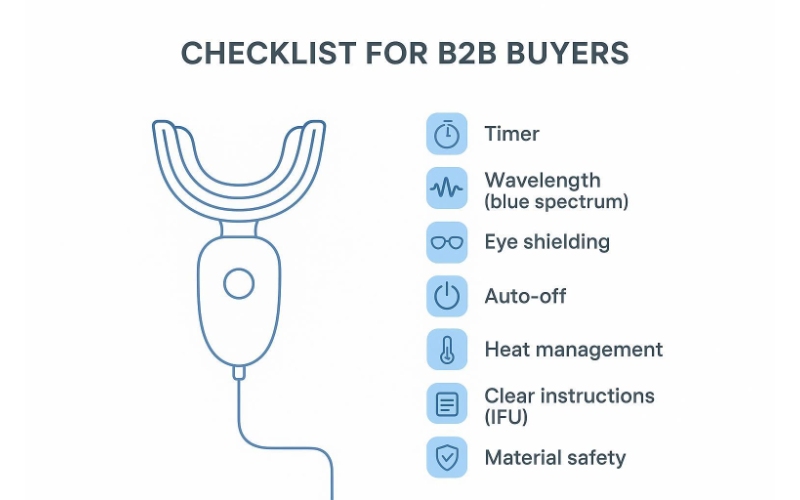
If your business is sourcing devices for resale, your biggest risk is not only clinical—it’s returns, bad reviews, and compliance friction.
Use this checklist to qualify systems before you commit to a production run.
What to verify | Why it matters | What “good” looks like |
|---|---|---|
Timer + auto shutoff | Prevents overexposure and user improvisation | fixed session length with auto-off |
Low-heat behavior | Heat increases discomfort risk and user distrust | “cold light” feel; no overheating reports |
Clear positioning (LED vs UV) | Reduces compliance ambiguity | conservative, specific LED language |
User-facing IFU | Most incidents are user error | step-by-step use + limits + stop rules |
Tray compatibility & guidance | Fit drives gel containment and comfort | clear tray fit and gel placement guidance |
If you want a concrete example of how suppliers present device-level features for evaluation, review a dedicated device page such as wireless mouth-tray LED whitening light and translate features into your own spec and labeling requirements.
If you’re building a private-label line, Onuge is one manufacturer in this category. A practical way to evaluate fit is to review a system page like blue light teeth whitening device and compare it to your checklist (timer behavior, form factor, kit components, and documentation quality).
A structure that reduces misuse:
Who should not use the product (e.g., active gum disease, untreated cavities, persistent pain—refer to a dentist)
How much gel to use (and where to place it)
Exact session time (no “as long as you want”)
Maximum frequency (and a clear pause rule if sensitivity occurs)
Aftercare expectations (what’s normal vs what’s not)
If you need a reference for step-by-step clarity, how to use a dental whitening kit is a helpful example of the types of steps end users commonly misunderstand.
Tray fit also matters more than most product pages admit. If you’re deciding what tray material to include (or how to position it), silicone vs TPE mouth trays gives useful framing for comfort and compatibility.
Often yes—when the device is low-heat and the protocol is constrained. Home use becomes risky when instructions are loose and users overextend time or frequency.
Not necessarily. Teeth whitening sensitivity is common and often temporary. Your IFU should include a clear stop rule and guidance on when to consult a dentist.
In general, yes. The safest operational stance is to prefer LED and avoid UV-style positioning. In buyer language, that’s blue light vs UV teeth whitening—choose low-heat, controlled-exposure systems.
They’re different formats with different failure modes. If you’re deciding between product types (or merchandising both), see whitening light vs strips for a category-level comparison.